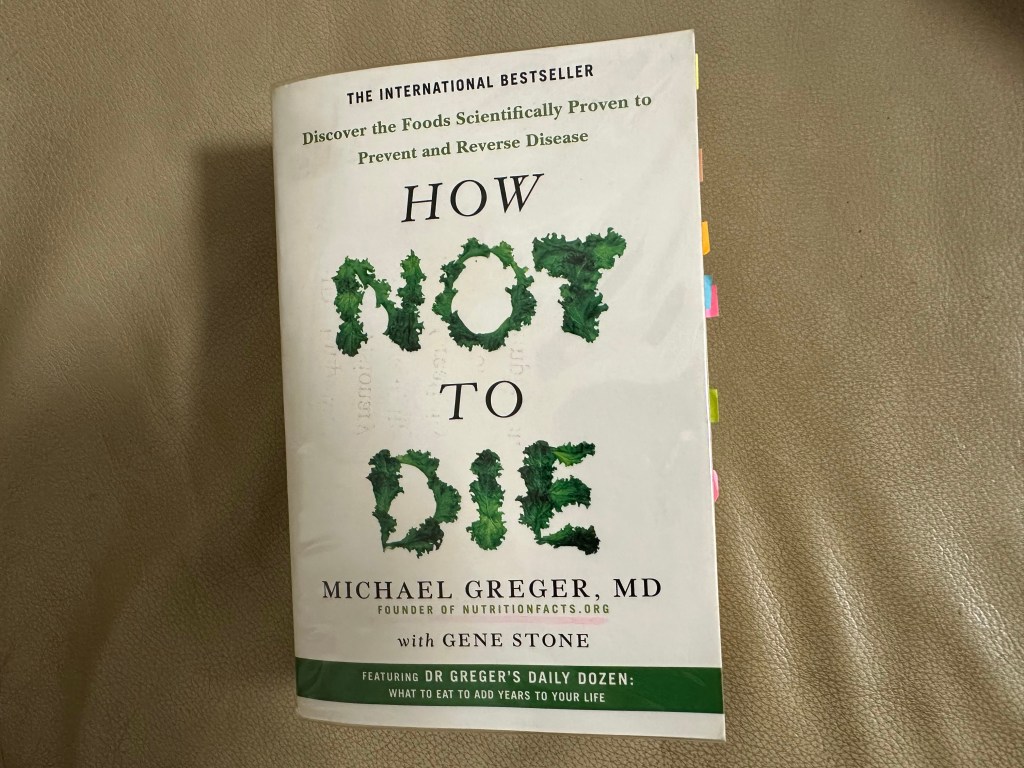
The book How Not to Die presents an ambitious, evidence-forward case that most premature death and disability from chronic disease are substantially preventable—and, in selected conditions, potentially modifiable after diagnosis—through dietary and lifestyle change centered on whole plant foods. The book’s signature move is structural as much as scientific: it organizes nutrition advice around the “top killers” (disease-by-disease) and then distills the message into a pragmatic checklist (the Daily Dozen) designed to convert abstract epidemiology into daily behavior.
As a reading experience, it is persuasive, earnest, and densely referential—especially attractive to readers who want a “why” for every recommendation. Its strongest contribution is not a novel macronutrient theory, but a pattern-level argument that aligns with many mainstream medical and public-health principles: eat more fruits/vegetables/whole grains/legumes, emphasize minimally processed foods, limit added sugars and excess sodium, and build habits that support cardiometabolic health across the life course.
The book’s weaknesses flow from the same engine that powers its strengths. The narrative sometimes reads as more certain than nutrition science typically allows, especially when inferential steps bridge small trials, surrogate endpoints, short interventions, or mechanistic findings to broad clinical promises. Major critics focus on selective emphasis (“cherry-picking”), ideological drift, and overconfident extrapolation—concerns that deserve consideration even if one agrees with the plant-forward direction.
Overall, we recommend How Not to Die as a high-utility framework and motivational synthesis—best used as a starting map rather than a final verdict and ideally paired with guideline-level context and individualized clinical judgment.
Scope, structure, and central thesis
How Not to Die (first published in 2015 and co-written with Gene Stone) is framed as a physician’s counterweight to a healthcare system that excels at acute rescue but underdelivers on chronic-disease prevention. Its central thesis is that dietary pattern is a dominant, modifiable driver of the leading causes of death, and that a predominantly whole-food, plant-based pattern can prevent—and sometimes meaningfully treat—many of them.
The book’s architecture is unusually explicit. A table-of-contents view shows a disease-first sequence—heart disease, lung disease, brain disease, digestive cancers, infections, diabetes, high blood pressure, liver disease, blood cancers, kidney disease, breast cancer, suicidal depression, prostate cancer, Parkinson’s disease, and iatrogenic causes—followed by practical chapters culminating in “Dr. Greger’s Daily Dozen,” with food-group chapters and an appendix on supplements.
That format matters for analysis. By making each chapter an “X disease → Y nutritional lever” story, the book is designed to (a) keep readers engaged via relevance (“start with the condition you fear most”) and (b) create the impression of targeted, evidence-backed “actions” rather than generic wellness advice. The second half’s checklist then attempts to harmonize those disease-specific levers into one daily pattern.
A practical note for 2026 readers: a substantially expanded “Revised and Updated” edition was released in December 2025 (publisher-listed at 672 pages), positioned as incorporating newer science while keeping the same overall premise.
Leading causes of death are largely chronic diseases
Diet and lifestyle are major modifiable drivers
For each major disease: identify dietary factors that worsen risk
For each major disease: identify foods/patterns linked to lower risk or better outcomes
Converge on a whole-food, plant-forward dietary pattern
Translate pattern into daily checklist and habits
Adoption supports prevention, risk reduction, and in some cases clinical improvement
Show code
Evidence base and key dietary recommendations
The Daily Dozen as the book’s “applied thesis”
Greger’s most durable contribution is arguably not any single food claim, but the Daily Dozen—a checklist that functions as an “implementation layer” for the book’s evidence synthesis. On NutritionFacts.org, the checklist is presented as “not a meal plan,” but an “aspirational minimum” intended to be adapted to individual needs. It specifies daily targets for beans (3), berries (1), other fruits (3), greens (2), cruciferous vegetables (1), other vegetables (2), flaxseed (1), nuts/seeds (1), herbs/spices (1), whole grains (3), beverages (about 60 oz), exercise (daily), and it explicitly calls out vitamin B12 supplementation (weekly or daily dosing guidance).
From an analytic standpoint, the checklist does three things well:
First, it operationalizes diet quality in food terms rather than macro targets—aligning with a growing consensus that patterns often matter more than isolated nutrients.
Second, it emphasizes “healthy plant-based” rather than “plant-based by label,” rejecting the idea that all vegan foods are nutritionally equivalent.
Third, it foregrounds a real constraint of strict plant-based eating: nutrient planning. The explicit B12 recommendation is scientifically responsible and consistent with professional positions that vegan diets can be healthful but require attention to potential deficiencies.
Key evidentiary motifs Greger relies on
Across chapters, Greger’s evidentiary style tends to braid four strands: prospective cohort associations, randomized trials (when available), mechanistic plausibility, and the “review-of-reviews” logic that privileges bodies of evidence over single studies.
To illustrate what this looks like in practice (and where it is strong vs. thin), a few representative “book-type” claims are worth examining.
Cardiovascular disease and the prevention–reversal spectrum.
Greger’s strongest domain is cardiometabolic disease, where dietary patterns rich in fruits, vegetables, and whole grains have long-standing guideline support. The American Heart Association scientific statement on dietary guidance emphasizes whole dietary patterns, variety of fruits/vegetables, whole grains, minimally processed foods, limited added sugars and salt, and use of liquid plant oils; it also allows for protein sources that can include fish/seafood and low-fat dairy, with lean meats if needed.
Where the book reaches further is “reversal.” There is genuine evidence that intensive lifestyle programs can produce regression of coronary atherosclerosis in selected patients—classic work includes Dean Ornish’s long-term trial of intensive lifestyle change reporting greater regression over time in the intervention group.
However, the clinical reality is that “reversal” evidence is not synonymous with “a single dietary tweak reverses disease,” and even supportive trials typically combine diet with other intensive elements (stress management, exercise, group support). That nuance is essential when translating the book’s rhetoric into patient expectations.
Blood pressure: robust pattern evidence, mixed single-food messaging.
For hypertension, the scientific baseline is strong: the DASH trial (Dietary Approaches to Stop Hypertension) feeding trial demonstrated meaningful reductions in blood pressure from a diet emphasizing fruits, vegetables, and low-fat dairy with reduced saturated fat, with larger effects among participants with hypertension.
Greger often complements pattern evidence with “spotlight” foods and beverages. Hibiscus is a good example: a randomized comparison found a standardized hibiscus extract reduced blood pressure with no significant difference from captopril at study end, and later meta-analytic work suggests hibiscus can lower systolic blood pressure versus placebo, though heterogeneity is high and comparisons with pharmaceuticals are not uniformly definitive.
In a book-review frame, this is where Greger’s strengths and risks co-exist: he makes evidence legible, but readers may overinterpret adjunctive findings as medication substitutes without clinician oversight.
Diabetes: plant-forward patterns are supported, but “best diet” framing can be too absolute.
Professional guidance increasingly emphasizes diet quality and personalization in diabetes care. The American Diabetes Association Standards of Care are explicitly person-centered and updated annually; nutrition therapy appears as an ongoing, structured component of care.
Evidence syntheses also support vegetarian/vegan patterns as potentially beneficial for type 2 diabetes management (e.g., improvements in weight and glycemic control in some trials), though adherence, diet quality, and comparison diets matter.
Greger’s book fits comfortably within “plant-forward is a safe bet,” but becomes more contestable when it implies singular superiority independent of context. The contemporary literature increasingly distinguishes healthy plant-based patterns from “plant-based junk,” and finds outcomes track that quality distinction.
Cancer chapters: alignment with major preventive guidance, but treatment-adjacent claims need careful framing.
On prevention, Greger’s emphasis on plant foods, fiber-rich diets, and minimizing processed meat aligns with major cancer-prevention bodies. World Cancer Research Fund recommends limiting red meat and consuming very little, if any, processed meat.
On survivorship and treatment-adjacent claims, the book highlights foods such as soy and flax. Contemporary reviews suggest postdiagnosis soy/isoflavone intake is not associated with worse outcomes and may be associated with lower recurrence or mortality in some observational contexts, though causality is difficult to establish.
For flaxseed and prostate cancer, a randomized presurgery trial reported effects on biomarkers such as tumor proliferation rates, but this remains far from definitive evidence of long-term clinical endpoints.
As a reviewer, I view these chapters as valuable in encouraging dietary quality and skepticism of “nothing matters,” but they require disciplined language: food can be supportive, but it is not interchangeable with oncologic treatment.
Liver disease and coffee: a “mainstream-leaning” example.
Greger’s use of coffee as a protective factor for liver health is comparatively well-supported by large-scale syntheses. An umbrella review in The BMJ reported associations between coffee consumption and lower risk across multiple outcomes, including non-alcoholic fatty liver disease in pooled evidence.
More focused meta-analytic work in NAFLD populations suggests coffee consumption is associated with lower odds of significant liver fibrosis, though thresholds and causality remain open questions.
This type of claim—supported by multiple studies but still framed as risk association rather than guaranteed protection—is where the book is most credible and most useful.
Scientific credibility, strengths, and limitations
Strengths
The book’s strongest scientific virtue is its rhetorical insistence that the totality of evidence matters more than a single “breakthrough” study. In the author’s own audio content, Greger explicitly explains “best available balance of evidence” as a preference for systematic reviews/meta-analyses (and even “reviews of reviews”) when interpreting diet-health relationships.
A second strength is transparency culture. The surrounding ecosystem—videos, transcripts, and “doctor’s notes”—is designed to show sources and provide traceability, and the organization describes an internal workflow of reading, synthesizing, and fact-checking before publication.
Third, the book’s directional thrust tracks major institutional guidance: emphasize fruits/vegetables, whole grains, minimally processed foods; reduce added sugars and excess sodium; pursue long-run dietary patterns, not hacks. While Greger is more restrictive than many guidelines (especially regarding oils and animal foods), the core “move toward plants” is not fringe.
Finally, as a practical science-communication object, the Daily Dozen is a well-engineered behavioral scaffold: it is specific enough to be actionable yet broad enough to suit many cuisines, and it acknowledges supplementation where necessary.
Limitations and credibility stress-points
The biggest credibility stress-point is not “plant foods are healthy”—that is widely supported—but the book’s gradient of certainty. Critics argue that Greger sometimes overstates claims, treats suggestive evidence as decisive, and constructs a cleaner narrative than messy literatures warrant. A widely read critique in Healthline explicitly frames the book as vulnerable to cherry-picking and misrepresentation, even while praising its scope and usefulness to readers who keep a critical stance.
Similarly, Office for Science and Society – McGill University critiques Greger for ideological bias and for sometimes treating preliminary or weak evidence (often around plant compounds) as more persuasive than it is.
A second limitation is what I would call “therapeutic compression”: the leap from risk factor improvement to disease reversal to mortality reduction can be rhetorically compressed in popular nutrition writing. Even when the underlying studies are legitimate, the patient-facing meaning is not always equivalent. Ornish-style regression work is real but intensive, multi-component, and not automatically generalizable to typical self-guided readers.
Third, the book’s dietary strictness can be both a feature and a bug. Some readers do best with clear rules; others need a “good-better-best” continuum. Modern healthy-aging evidence often favors diets rich in plant foods with some inclusion of healthy animal-based foods, suggesting that strict exclusion is not always necessary for population-level benefit.
Fourth, an ideological bias can exist even without conventional commercial conflicts. Greger’s public positioning is intentionally non-commercial—no ads, no corporate sponsorships—and his organization states that book/speaking proceeds are donated to charity.
At the same time, the organization’s own FAQ notes he draws a salary from the nonprofit, meaning reputational and occupational incentives still exist even when product-selling incentives are muted.
This doesn’t invalidate the work; it simply reinforces the meta-lesson Greger himself teaches: never rely on one source, and always stress-test claims against the broader evidence base.
Practical applicability for different audiences
For general readers, the book’s practical value is high if approached as an evidence-informed lifestyle manual rather than a guarantee. The Daily Dozen provides an unusually concrete target set (including exercise) and is explicitly positioned as adaptable, which can reduce perfectionism and “all-or-nothing” failure cycles.
The main risk is cognitive: a disease-by-disease structure can encourage “nutritional sniping” (chasing single foods for single outcomes) rather than building a sustainable dietary pattern and food environment. Here, I would advise readers—consistent with major cardiovascular guidance—to treat the checklist as a pattern anchor and focus on repeatable meals, shopping habits, and food prep routines.
For clinicians, How Not to Die is best understood as a patient-motivation resource that can support counseling on diet quality—especially for cardiometabolic risk—rather than as a prescriptive protocol to be adopted wholesale. The book can help clinicians explain why “dietary patterns” matter, but clinical translation must respect medication management, comorbidities, and nutrition adequacy.
I see particular utility in using the book to start structured conversations: “Which Daily Dozen categories are easiest for you?” and “Which is hardest given your time, budget, and culture?” That aligns with the AHA’s emphasis on flexibility across preferences and life stages, and on structural barriers to adherence.
For registered dietitians and nutritionists, the book is a rich library of claims but requires professional filtration. On the plus side, it dovetails with professional consensus that well-planned vegetarian/vegan diets can be nutritionally adequate and may confer cardiometabolic benefits; on the caution side, it risks being misused by clients who self-prescribe overly restrictive patterns without attention to energy needs, GI tolerance, micronutrients, or cultural fit.
In practice, diet professionals can leverage the Daily Dozen as a food-group coverage checklist while still allowing culinary oils when appropriate, strategically incorporating fortified foods, and tailoring fiber load and protein distribution for older adults, frail patients, or those with GI or renal limitations.
Comparisons, controversies, and critiques
How Not to Die competes in a crowded ecosystem of longevity/diet books. What differentiates it is its “top killers” structure and its heavy emphasis on micro-targeted food recommendations, anchored by a checklist system. Competitors often emphasize either (a) ethnographic longevity patterns, (b) fasting biology, or (c) a more explicitly weight-loss-centric framework.
| Comparable work | Core approach vs. Greger | Where it complements/competes |
| The Longevity Diet — Valter Longo | Plant-forward but not strictly vegan; integrates periodic fasting-mimicking cycles and life-stage protein guidance. | Competes on longevity framing; complements Greger by adding fasting/time-restriction and a less absolutist stance on fish. |
| The Blue Zones — Dan Buettner | Observational/ethnographic “Power 9” lifestyle pattern (movement, purpose, community, plant-slanted eating) rather than disease-by-disease nutrition mechanisms. | Complements by broadening beyond diet into environment and social structure; competes less on mechanistic nutrition claims. |
| The China Study — T. Colin Campbell | Whole-food plant-based advocacy rooted heavily in ecological/epidemiologic interpretations and critique of industry/policy; less of a daily behavior checklist. | Aligns philosophically with Greger; competes for “plant-based = prevention” territory but is often criticized for inferential leaps. |
| Eat to Live — Joel Fuhrman | Nutrient-density (“Nutritarian”) focus, with explicit weight-loss programmatics and food acronyms (G-BOMBS). | Competes strongly on behavior-shaping; complements Greger by offering more meal-plan-like structure but can be experienced as restrictive. |
Major controversies and how Greger answers them
The most persistent controversy is selective evidence use (“cherry-picking”) and overconfident interpretation. Critics argue the narrative’s clarity is partly achieved by emphasizing supportive studies while minimizing conflicting results or limitations, and by presenting nutrition as more black-and-white than warranted.
Greger’s response, as reflected across his broader content, is less a point-by-point debate and more an epistemic stance: use the “best available balance of evidence,” prefer systematic reviews/meta-analyses, and remain alert to industry funding bias that can distort reviews and conclusions.
He also emphasizes transparency infrastructure (sources, transcripts, and research workflow) and positions the project as non-commercial, claiming no ads/sponsors and donation of proceeds.
A second controversy is practical strictness and “food-as-medicine” messaging. Some critiques focus less on whether plant-forward eating is beneficial (often conceded) and more on whether Greger’s “optimum” pattern is unnecessarily restrictive or psychologically burdensome for many.
Greger’s practical rejoinder is embedded directly in the Daily Dozen framing: it is a customizable checklist, not a rigid meal plan, and it is explicitly “aspirational.”
Finally, there is the reversal controversy. Even sympathetic analysts caution that “reversal” language can outrun typical evidence, which more reliably supports risk reduction and risk-factor improvement than guaranteed anatomic reversal for most people.
This is less a “gotcha” and more a translation issue: lay readers may treat “often stop it in its tracks” rhetoric as a promise. A careful review should explicitly separate (1) prevention, (2) adjunctive support after diagnosis, and (3) disease regression in highly selected contexts.
Overall assessment and recommendation
How Not to Die is an unusually systematic attempt to connect nutrition science to the most feared endpoints—heart attacks, cancers, neurodegeneration, diabetes complications—and then to turn that science into daily action via a checklist architecture. On its best pages, it models a powerful public-health intuition: the most reliable dietary wins come from pattern-level shifts toward minimally processed, plant-forward eating and away from ultra-processed calories, excess sodium, and added sugars. That intuition closely tracks major institutional guidance.
Where the book is most vulnerable is not in its directional advice but in its rhetorical certainty and in its tendency to convert heterogeneous evidence into strong-sounding conclusions. Critics’ concerns about selective emphasis and ideological drift are credible enough that readers should not treat the book as a solitary authority.
Used wisely, though—especially when paired with guideline-level context and individualized care—it can function as a high-impact catalyst for better eating.
Our recommendation: we endorse the book for motivated general readers and for clinicians/dietitians seeking a persuasive patient-facing narrative—provided it is accompanied by clear “translation guardrails”: emphasize overall dietary pattern, avoid magical thinking about single foods, respect supplementation realities (B12), and integrate medical oversight when disease and medications are in play.
Wellner Chan
 Global Wellness Digest
Leave a comment